Encrypted vault for your Bitcoin seeds.
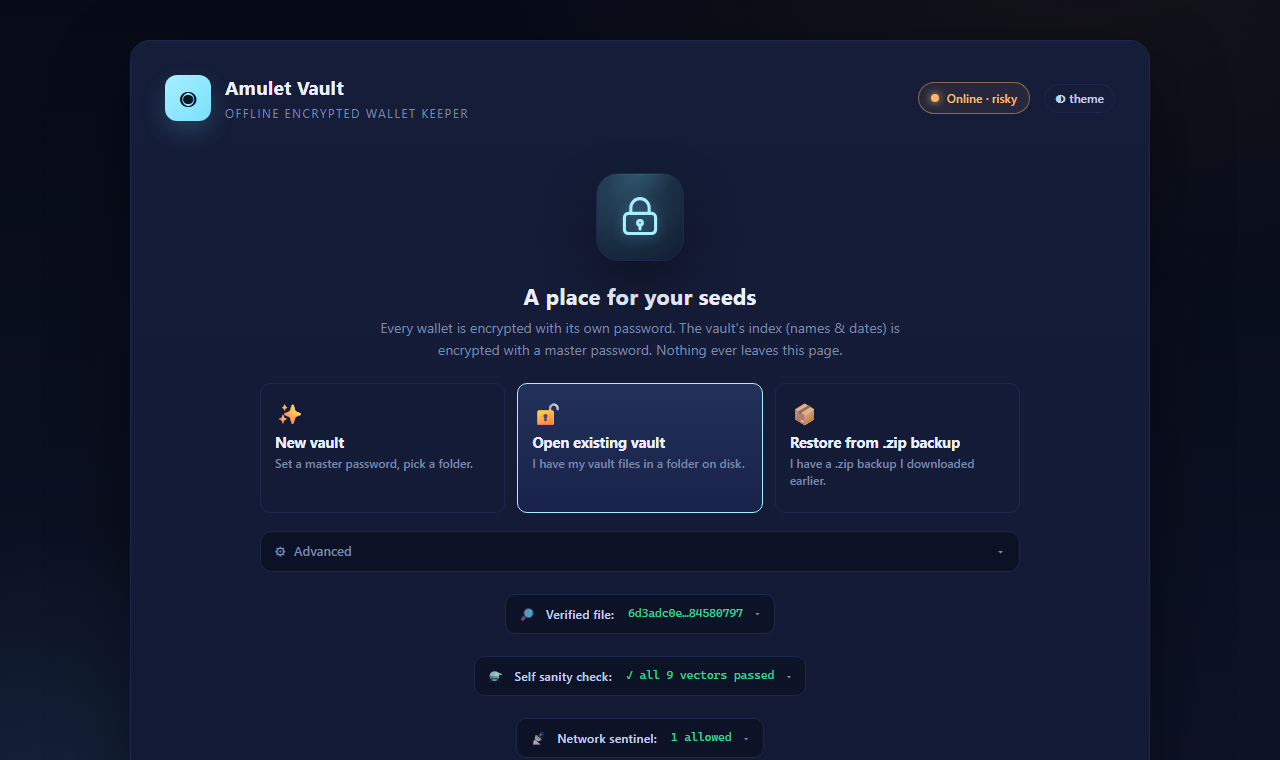
Amulet Vault keeps your seed phrases in encrypted files on your own disk or USB stick. Every wallet has its own password, the list of wallets is locked behind a master password, and nothing is ever uploaded. It is one HTML file that works offline.
For real funds: download, check the SHA-256, then run it from disk on an offline machine.
What it does
- Encrypts every wallet in its own file with AES-GCM-256, with keys derived by Argon2id.
- Locks the vault index (wallet names and dates) behind a separate master password.
- Shows the first receive addresses for Legacy, Nested SegWit, Native SegWit and Taproot, so you can check a wallet without spending from it.
- Exports a watch-only file with public keys only, for checking balances on another device.
- Backs up the whole vault to a single .zip you can copy anywhere.
How to use it
- 1Download, verify, go offlineSave the file, check its SHA-256, then disconnect before you handle real seeds.
- 2Create a vaultChoose a master password and a folder. In Chromium browsers the vault saves straight to that folder.
- 3Add your walletsPaste a seed phrase and give that wallet its own password. Each wallet becomes one encrypted file.
- 4Back up and export watch-onlyDownload the backup .zip, and export a watch-only file if you want to check balances without exposing a seed.
No step needs the internet. The whole tool runs offline.
Good to know
- The vault does not show balances or transactions. That would need the network, and the vault deliberately blocks it. Use the watch-only balance checker for that.
- If you forget a wallet password there is no reset. The encryption is the point.
- Direct folder saving needs a Chromium-based browser. Other browsers keep the vault in memory until you download the backup .zip.
Where this fits
This tool is one step in a complete offline workflow. Each step is a separate file, so you only use what you need.
Questions
Where is my seed stored?
Only in encrypted files on your own device, in the folder you choose. There is no server, account or cloud copy.
What happens if this website disappears?
Nothing. The vault is a file you keep. A separate open-source Python script, Amulet Relic, can also decrypt the wallet files without the vault.
How is this different from a password manager?
It is built for seed phrases: it derives Bitcoin addresses so you can confirm a wallet, exports watch-only keys, and runs offline from a single file you can verify.
Don't trust. Verify.
Every Amulet tool is a single HTML file with its SHA-256 published in SHA256SUMS.txt and its full source on Codeberg. The verify page shows how to check a file in under a minute.